Available Now
The Permission
to Be Right
How Knowledge Advances and Why It Sometimes Doesn't
How Knowledge Advances and Why It Sometimes Doesn't
Why did Kerala astronomers and Tycho Brahe independently arrive at the same planetary model, and why did both traditions stop there?
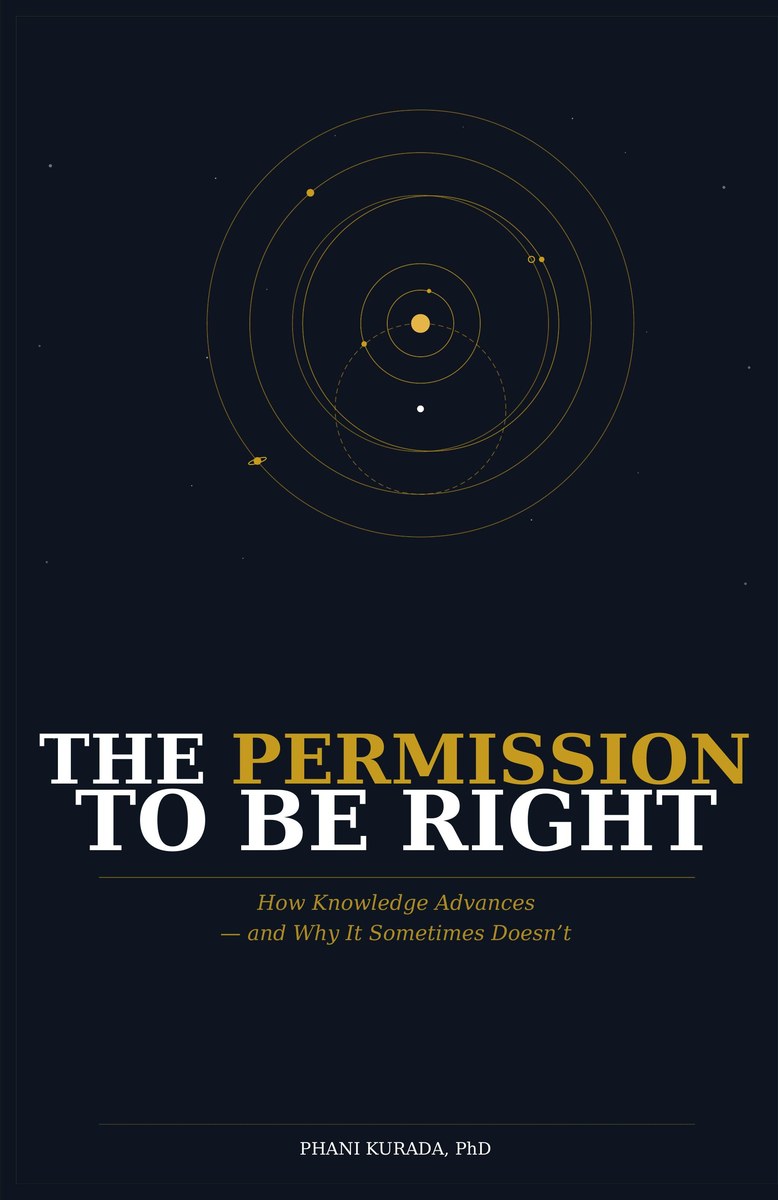
By the early sixteenth century, the Kerala astronomer Nīlakaṇṭha Somayājī had developed a geo-heliocentric model: all five planets orbiting the Sun, the Sun orbiting the Earth. It was strikingly comparable to the system Tycho Brahe would construct in Europe decades later. This was not a failed heliocentrism. It was a historically stable solution under pre-Keplerian observational conditions.
In The Permission to Be Right, Phani Kurada traces the long arc of Indian astronomy, from Āryabhaṭa to the Kerala School, to ask why systems stabilize at working solutions, and what it takes for an anomaly to become a verdict.
The answer is structural. Systems do not break because anomalies exist. They break when anomalies become impossible to absorb.
The second part asks the same question in a different domain: contemporary American medicine, a system whose most consequential failures leave no record. The mechanism is the same. The stakes are higher.
Drawing on the work of K. S. Shukla, K. V. Sarma, Kim Plofker, and George Joseph in the history of Indian mathematics, and on Kuhn, Lakatos, and Taleb in the philosophy of science. For readers in history of science, Indian intellectual traditions, philosophy of knowledge, and medical epistemology.
Systems do not break because anomalies exist.From The Permission to Be Right
They break when anomalies become impossible to absorb.
In the fourteenth century Mādhava of Sangamagrāma wrote the sine as an infinite series, a result Europe would not reach for two and a half centuries. Why the same series opened a new science in Europe and stayed a finished, admired result in Kerala. On instruments, methods, and the difference between producing a result and being unsettled by it.
Read the essayTwenty-nine drugs came off the US market for safety between 1990 and 2024. Sixty-three published papers reported the pivotal trials behind them, and not one carries any record of the withdrawal that followed. On why the correction machinery cannot carry this fact, and what the indexes were built to say instead.
Read the essayMedicine can see the harm it does with precision, and has built nothing that forces it to act. Traced through Vioxx, aducanumab, and the pulse oximeter that misreads darker skin: three of its most scrutinized failures, four decades apart, sharing one mechanism.
Read the essayMercury's orbit is far less circular than Mars's, yet it was Mars that broke two thousand years of circular astronomy. Why a discovery follows the cleanest signal rather than the largest, and what that explains about Nīlakaṇṭha, who built Tycho's system a century early in Kerala and still never reached Kepler's ellipse.
Read the essayHow ancient India didn't so much invent zero as spend centuries becoming the civilization most likely to produce it. On cosmological numbers, Pāṇini's grammar, and the mnemonic discipline that prepared the ground long before anyone wrote a numeral.
Read the essayThe same analytical framework, turned on academia itself, the anomalies a knowledge-producing institution has accumulated, and the structural conditions that determine which of them force change.
In developmentThe deferent circle, the manda epicycle, the śīghra correction: see the geometry of how Indian astronomers computed planetary positions a thousand years before Kepler, and the single revision that Nīlakaṇṭha would later make to it.
Open the visualizationPhani Kurada holds a PhD in molecular biology and has spent three decades working across scientific research and software systems.
His writing examines how scientific, scholarly, and institutional traditions shape what their thinkers can say. The current project sits at the intersection of intellectual history, the philosophy of science, and the structural analysis of knowledge systems, with recurring engagement with the history of Indian mathematics and astronomy.
The Permission to Be Right is his first book.
Currently based in Littleton, Massachusetts.